
Cleveland County Resident Lookup Records
A cross-checking process is more reliable than a single master list. The Assessor answers who is recorded as owner or tax contact for a parcel. The County Clerk shows recorded property interests. The voter portal tests an individual registration with identity information. OSCN shows public docket activity. Older vital indexes, business records, and state boards can add dated context. Read every result for its jurisdiction, source date, and privacy boundary before connecting it to a person.
| Official record | Fact it can support | Cleveland County route | Access boundary |
|---|---|---|---|
| Assessor parcel | Recorded owner, parcel, and tax-mailing clue | Spatialest and County Assessor | Public search; inspect live card fields |
| Recorded document | Transfer, lien, or legal description | County Clerk index and office | Public index; originals or copies at the custodian |
| Voter registration | Registration identity, precinct, and status | OK Voter Portal or Election Board | Date of birth required; protected fields withheld |
| Court docket | Party, case, event, and disposition | OSCN and Court Clerk | Public docket; files may be sealed or require a request |
| Birth or death index | Older event name, date, county, and sex | OK2Explore and OSDH | Index age rules differ from certificate eligibility |
| Business or license record | Entity affiliation or credential status | SOS and the responsible state board | Address may be a service or office contact |
Begin with an address when the question is ownership or a parcel history. Begin with name, date of birth, a time period, spouse, or business name when the person comes first. A last name alone needs narrowing before it becomes useful evidence.
Confirm a Cleveland County Resident Name
The same-name problem is central to a careful name check. Compare a full name, middle initial, date of birth or age when lawfully available, spouse, occupation, business name, address, parcel legal description, county, and time period. An assessor result may name a trustee or LLC. A court party can be a different person with the same name. A registration result without the required identity check is not enough to establish that a particular individual is the match.
Keep a short source log. One column should say what the record actually establishes, such as “owner of record,” “party in docket,” “directory occupant,” or “licensee.” Another should state the record date. Cleveland County sources are not synchronized, and later evidence should not silently overwrite an earlier historical record.
Match names with dates. A new source can refine a prior lead, but it should not turn a mailing address, court appearance, or old directory entry into a present-tense claim.
Check Cleveland County Court Dockets
The Oklahoma State Courts Network is the starting point for Cleveland County District Court dockets. Its official hub offers docket searches, non-OSCN county searches, case-number lookup, trial-disposition reports, daily dockets, and daily filings. Use name variants, former names, initials, a known case type, and an approximate year. The party-name page was protected during research, so live labels and pagination should be checked in the portal instead of assumed.
The OSCN docket-search hub is the source shown in this Cleveland County court-record image.
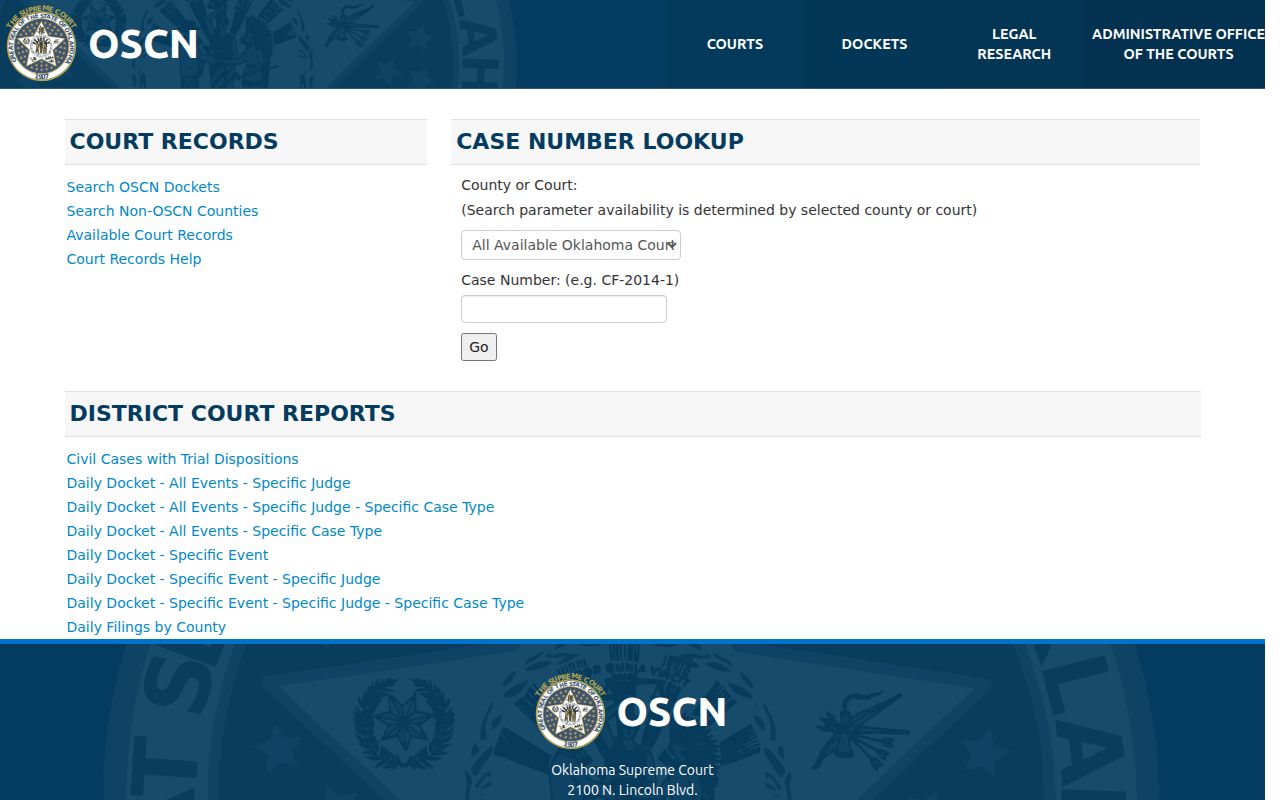
An online result normally supplies a case number, case type, filed date, party names, attorneys, events, and a disposition or status. That is an index of docket activity. It does not prove a current address, a finding against a person, or access to every underlying document.
| Case number | The unique court identifier to include in a request to the Clerk. |
|---|---|
| Case type | The docket category, which helps distinguish matters with similar parties. |
| Filed date and events | The timeline of the case record, not a present identity statement. |
| Disposition | The recorded case outcome or status, which should be described accurately. |
| Document availability | A cue to ask the Court Clerk for a particular existing document or certified copy. |
Verify Cleveland County Voter Records
The OK Voter Portal is a one-person, self-service check. It asks for the first name, last name, and date of birth as registered. A successful result may provide registration verification, polling place and early-voting information, sample ballot, districts, replacement voter-ID options, and address or party update functions. It does not reveal ballot choices, and it is not a tool for producing a street-wide list.
Oklahoma’s official voter portal is pictured here because it is an identity-limited source for a Cleveland County check.
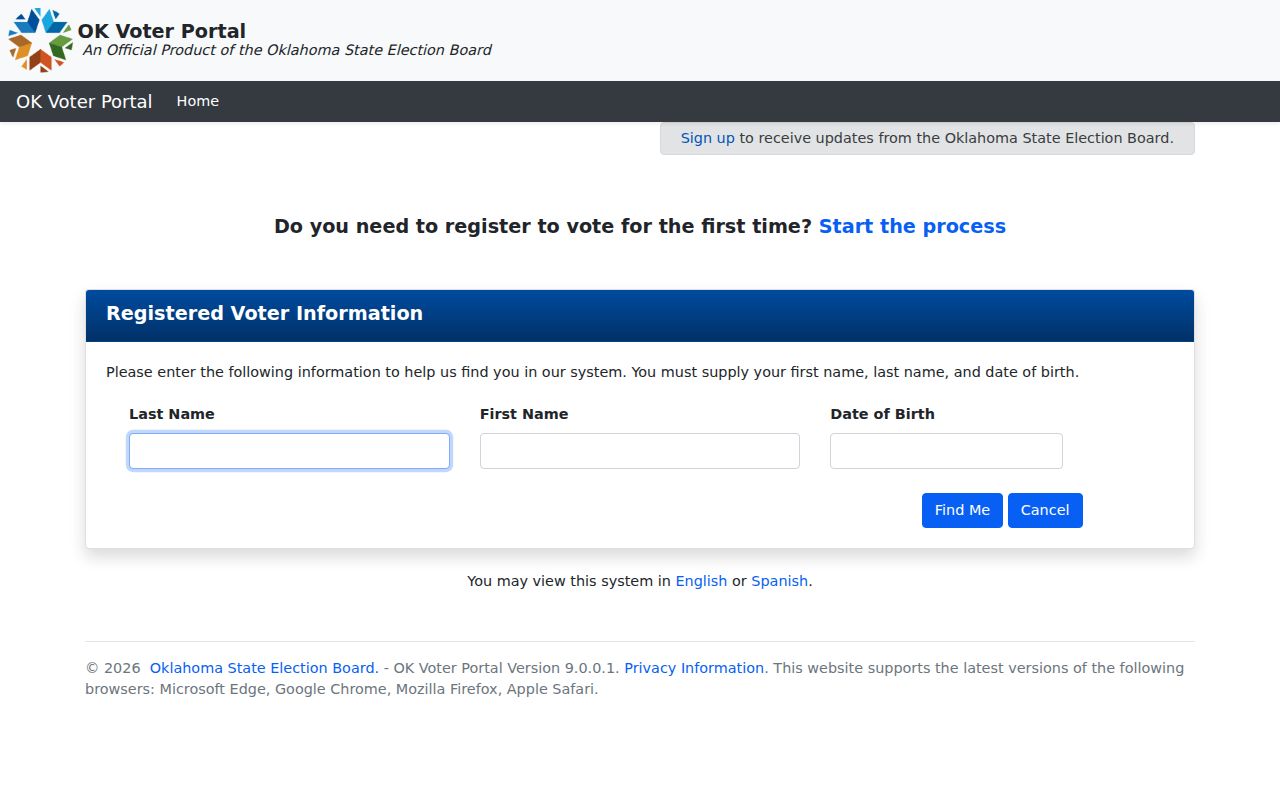
The date-of-birth requirement is a useful safeguard against a casual same-name match. If an entry needs correction, the Cleveland County Election Board is the proper custodian, rather than a searcher trying to infer a result from another source.
| Portal field | Input | Use in the check |
|---|---|---|
| First name | Required text | Enter the name as registered. |
| Last name | Required text | Use the registered spelling. |
| Date of birth | Required date | Provides identity verification for the lookup. |
| County | Not a visible basic-portal field in the inspected capture | Use Cleveland County board context when needed. |
Note: Oklahoma voter records have special privacy rules, and protected or ACP voters can have address information withheld from central displays.
Vital Indexes for Cleveland County Residents
For Cleveland County births and deaths, the issuing custodian is the Oklahoma State Department of Health Vital Records Service. OK2Explore is a public index, not an image repository. It searches event type, date, county, subject name, and sex. Births at least 20 years old and deaths at least 5 years old are generally indexed. A hit can support a historical lead, but it does not grant access to a certified certificate.
| Record | Index route | Certificate limit | Local companion source |
|---|---|---|---|
| Birth | OK2Explore after the index threshold | Restricted; the published opening rule is at least 125 years | Family histories, newspapers, and OHS research |
| Death | OK2Explore after the index threshold | Open after 50 years; newer records require recognized authority | Obituary, probate, and deed sequence |
| Marriage license | Court Clerk inquiry or OSCN route | Certified marriage license available from the Clerk | Local court record request |
| Divorce | OSCN docket | File access follows court rules, redaction, and sealing | Cleveland County Court Clerk |
Vital records began filing in October 1908 and became mandatory in 1917, with early gaps and uneven compliance. For an earlier family event, turn to courthouse books, church records, newspapers, cemetery books, OHS Gateway, and family histories rather than expecting a routine state certificate.
Cleveland County License Record Clues
Business and license records can distinguish people with the same name, but they establish a narrow fact. The Secretary of State summary can show an entity name, status, registered agent, address, registration date, state domicile, and authorized capital. Its registered office is a service contact, not a residence. Oklahoma has no single universal credential index. The responsible board depends on the record type.
The Oklahoma ABLE licensee search illustrates a board-specific source that can search by business, license, city, county, or licensee name.
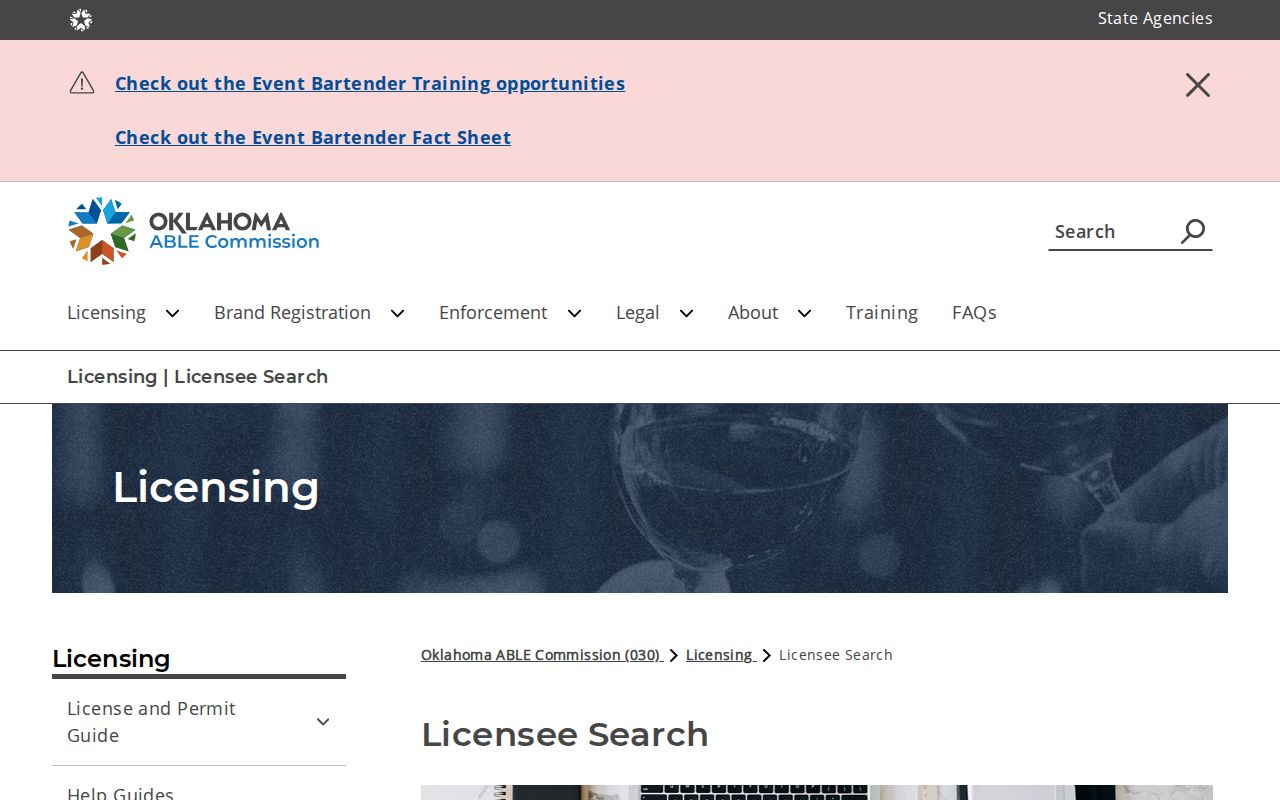
An ABLE result can show status, expiration, address, and violations as described by the agency. It may be a useful identity clue next to an entity filing or permit, but it does not prove that the licensee lives at a displayed address.
The state also directs relevant searches to the Construction Industries Board, Labor, Nursing, Professional Engineers and Land Surveyors, Accountancy, and Behavioral Health. Compare the license status date with a deed, directory, court result, or business filing before drawing a conclusion.
Verify a Cleveland County Resident Across Records
Anchor one fact at a time. A person-first question can start with the voter portal, OSCN, an entity filing, a board record, or a historical index. An address-first question can start with the Assessor and County Clerk. The aim is not to collect every mention of a name. It is to compare sources that answer compatible questions and state where the evidence stops.
- Write the full name, known name variants, a time period, and the single fact being checked.
- Run the official source that most directly answers that fact, then save its URL and date viewed.
- Use a second source to test a stable detail such as a spouse, parcel legal description, business affiliation, or case date.
- Ask the custodian for an existing document only when the online index points to a needed record.
- Describe the final result with its time limit, such as an owner of record, a docket party, or a historical directory occupant.
- Docket
- A court’s running index of a case, including parties, events, and recorded status.
- Index and image
- An index helps locate a record; an image is a scan of the document and may have separate access rules.
- Certified copy
- A copy issued and certified by the custodian for an official purpose, not merely a screen result.
Cleveland County Past Connection Records
For family history, a former classmate, or an estate question, historical sources usually offer the least intrusive path. The Oklahoma Historical Society, Pioneer Library, University of Oklahoma collections, and the Cleveland County Historical Society can help locate yearbooks, newspapers, family stories, city directories, and local research guidance. The Moore-Lindsay House archive and pioneer-story collection are especially useful for earlier families and community ties, but they are not a current resident roll.
An heir trail normally begins with an obituary or death-index lead, then moves to a probate docket, the documents needed to establish a relationship, and an estate deed or release in the County Clerk records. For a former classmate, start with a yearbook or school archive to establish a historic name and activity. Do not treat a public historical mention as an invitation to locate private, current contact details.
Cleveland County Record Boundaries
Public does not mean unrestricted. Oklahoma keeps driver-license information out of ordinary public-record searching, and voter records withhold driver-license and Social Security details. The Oklahoma Address Confidentiality Program gives qualifying participants a substitute address and related protections. Election Restricted Records also protect specified people and families. A protected address, sealed court file, or restricted vital record should never be bypassed with a less authoritative source.
Oklahoma’s violent-offender registry is a separate public-safety source, not a general identity directory.
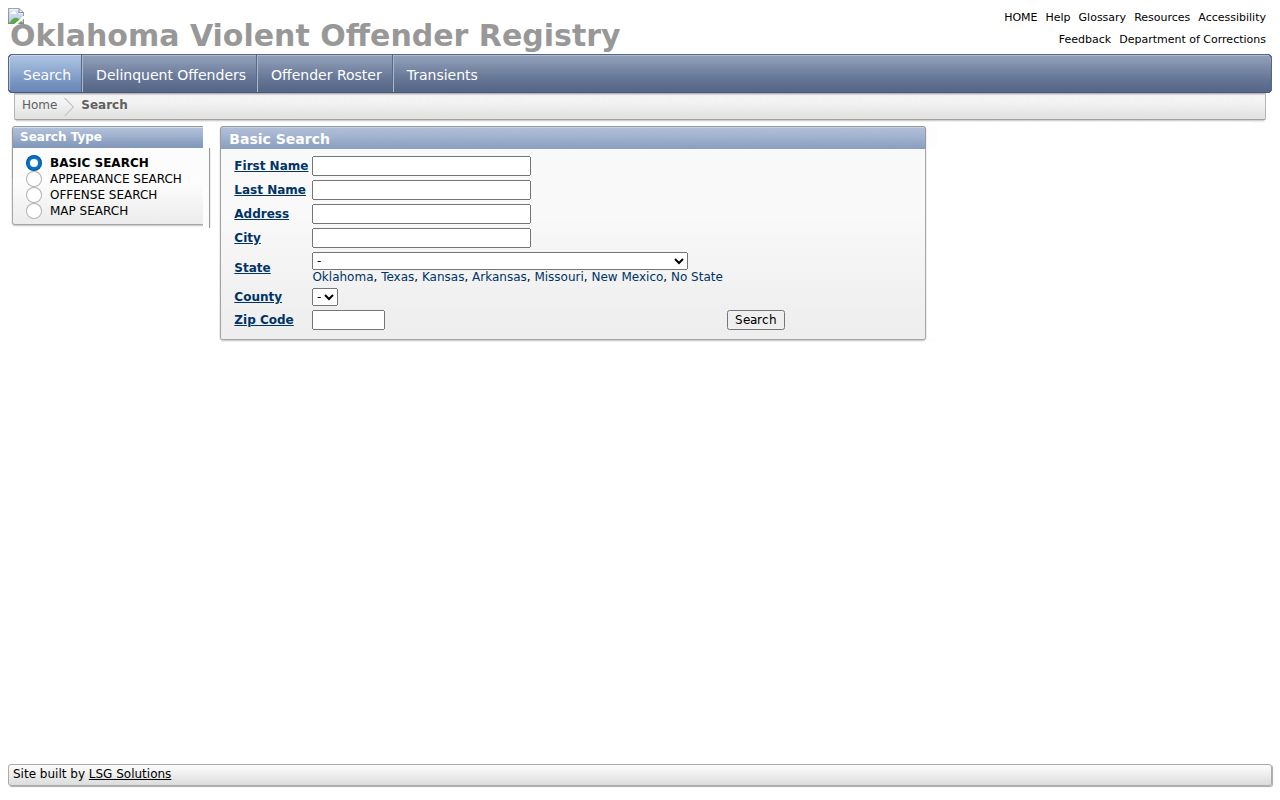
A registry result has its own scope, date, and agency context. It should be used only for lawful safety research, never to harass, threaten, or publicize a person beyond what the official source provides.
Lawful use. Use public records for a lawful personal purpose, protect sensitive details, and do not stalk, harass, intimidate, or harm any person.
Cleveland County Resident Records Requests
When an online source stops, ask the correct custodian for an existing record. The Oklahoma Open Records Act, 51 O.S. §§24A.1–24A.33, supports access to nonexempt government records but does not require an office to create a custom resident list. Cleveland County’s routing guidance sends land records to the County Clerk, valuation to the Assessor, tax material to the Treasurer, court matters to the Court Clerk, and election material to the Election Board.
State guidance permits reasonable access, redaction, and authorized copy or special-work costs. A clear request names the agency, existing record type, date range, person or case or parcel identifier, and preferred delivery. The Court Clerk accepts in-person, mail, and email requests, with posted copy and certification fees and a stated completion time of up to 10 business days after payment. Certified items cannot be emailed.
Note: If two sources conflict, preserve both dates and ask the office that controls the underlying record which document governs its own file.