
Cleveland County Previous Residents Sources
Different sources answer different parts of an address history. Current parcel information provides the starting identity for the land. Deeds move the ownership trail backward. Norman directory holdings, historic newspaper material, and federal census schedules can show a household in a particular period. A permit, map, obituary, or probate file can help date a structure or explain why a name leaves the trail. None of these sources, standing alone, proves every person who lived at an address.
| Source | Known coverage | Where held | What it can show |
|---|---|---|---|
| County deed index | Current indexed material; exact start not published | County Clerk and Cogov | Transfers, parties, instruments, legal descriptions |
| Older deed books and indexes | Before online coverage, sequence to confirm | County Clerk | Earlier grantor and grantee entries |
| Norman directories | At least 1926; cross-index material from the 1930s into the 1960s | Library and OHS | Address and household clues |
| Gateway newspaper directory block | 1893 sample | OHS Gateway | Historic county and Norman directory material |
| Federal census | 1900 through 1950 public household anchors | NARA and authorized databases | Dated household snapshot |
| Sanborn maps | Noble 1901; Norman references from 1915 through the 1940s | LOC and local collections | Structure and address context |
For a recent transfer, start with the parcel and deed. For a much older Cleveland County address, begin with the best dated source available and work both forward and backward. The online index has no published definitive start year, so an early no-match means the next step is the Clerk’s older material, not a conclusion that the address had no earlier history.
Cleveland County Parcel First
The present parcel is a firmer starting point than a street address alone. The county-linked Spatialest property search supports owner-name, physical-address, and parcel-map searches. Record the current owner as displayed, parcel number, situs address, mailing address, legal description, subdivision, and lot or block when the live record shows them. A situs address is the physical location of the parcel. A mailing address is where tax notices go, so it is not proof of occupancy.
Open the Cleveland County GIS description when an address does not line up with a deed. It explains lot-and-block, metes-and-bounds, coordinate, and rectangular-survey descriptions. A split lot, changed street number, or rural parcel can look like a different address until the legal description ties the records together.
Note: Save the parcel number and legal description before searching names, because both can outlast a changing street label.
Trace Cleveland County Previous Residents
The backward deed trail begins with the owner listed on today’s parcel record. Search that owner as the grantee in the Cleveland County recorded-document index, then confirm that the deed’s legal description matches the parcel. The grantor on that deed is usually the earlier owner or entity to search as a grantee. Repeating that handoff produces a chain of dated transfers, but each link still needs a document and legal-description check.
- Copy the parcel number, current owner, and legal description from the assessor record.
- Search the current owner as grantee near the likely acquisition period.
- Open the deed image when available and record the grantor, date, instrument number, and legal description.
- Search that grantor as grantee to locate the prior acquisition.
- Repeat with initials, full names, trusts, estates, married names, and entity variants, then ask the Clerk for older book or index access when the online trail stops.
- Grantor and grantee
- The grantor transfers an interest. The grantee receives it.
- Chain of title
- The sequence of recorded transfers connected by the same parcel or legal description.
- Legal description
- The lot, block, subdivision, survey, or metes-and-bounds identity used in land records. It is often more reliable than an old street number.
Cleveland County Clerk Index Rules
The County Clerk’s search instructions are part of the research method. Use exact formats, keep date ranges narrow enough to avoid an oversized result, append an asterisk after both last and first names when the index requires it, and use lot, block, and subdivision combinations for plat research. Search grantor and grantee roles separately. Those steps help distinguish a name match from a transfer tied to the specific parcel.
The County Clerk’s recorded-document search is the source for the image below. It is an index to land records, not a complete list of past residents.
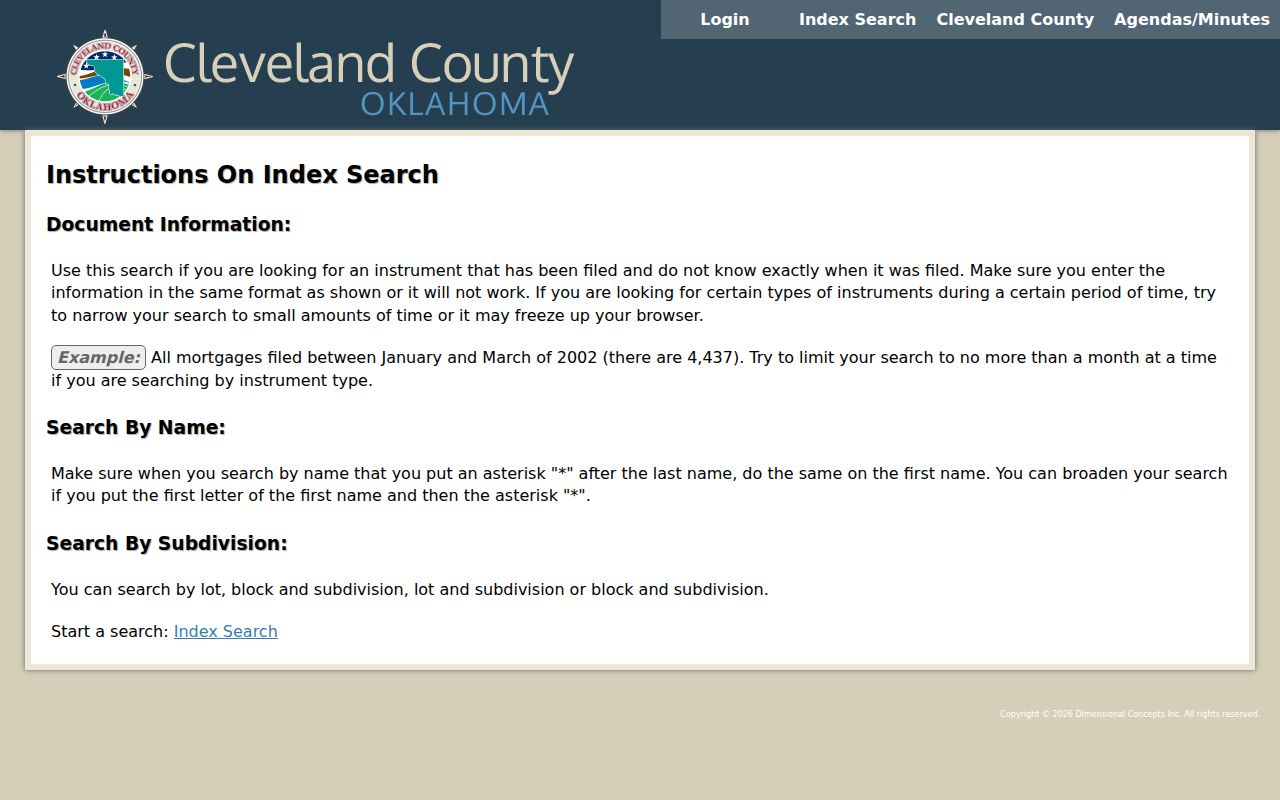
Use the index result to collect an instrument number and document date, then compare the document’s legal description with the assessor parcel before adding a name to the address history.
Cleveland County Past Address Gaps
Older online results may stop before the record trail does. Cleveland County has not published an exact digital cutover for the Clerk’s historical deed material. Ask for the service needed: an index search, deed-book inspection, image copy, certified copy, plat, lien release, or a historical record group. Those are separate requests, and the office can explain what survives in the relevant sequence.
The Clerk’s official index disclaimer warns that data may be inaccurate and that the index and images are not reliable proof of title, transfer, foreclosure, or present ownership. Inspect an original record at the Clerk’s office or request an office copy when the document affects a family-history or property-history conclusion.
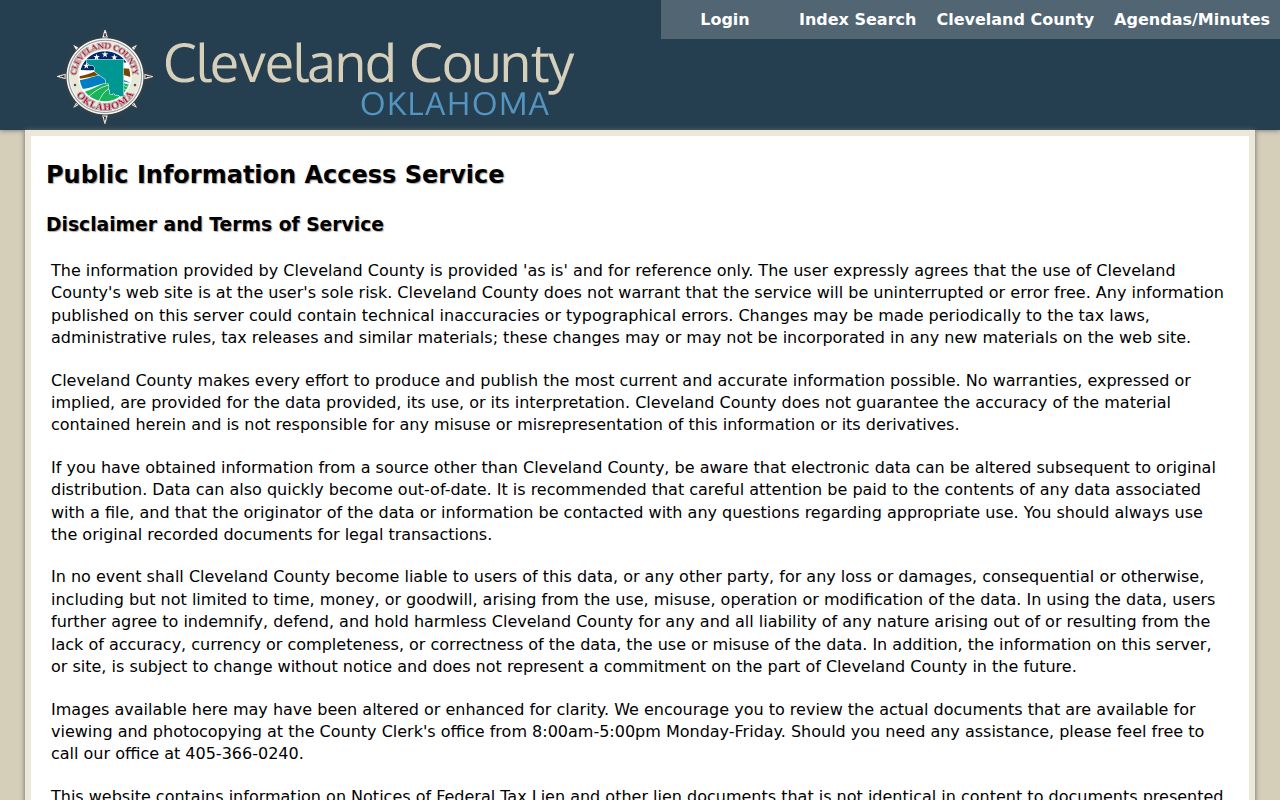
That warning is especially useful when an earlier name seems to fit the address but the legal description, instrument type, or source date does not match.
Cleveland County Directories and Census
Deeds show a land-interest trail, while directories and census schedules can anchor a household in a period. The Oklahoma Historical Society reports Norman Public Library directory holdings back to at least 1926, cross-index directories from the 1930s into the 1960s, and phone books from the 1960s. Exact volumes should be confirmed before treating a gap as meaningful. The OHS home-history guide recommends comparing directory entries with deeds, newspapers, subdivision names, and maps.
- Make a dated row for the address with the original street spelling and source volume.
- Add the person or household name, spouse if shown, and any address notation.
- Pair a directory year with the nearest public census anchor, rather than assuming both describe the same moment.
- Follow the address forward and each name backward and forward, noting when the source changes.
- Preserve a confidence note when a directory, census, and deed do not agree.
The public federal census anchors available for this work run through 1950 under the 72-year rule. The Cleveland County city directory page focuses on the collections themselves; here, the directory is one dated link in a specific address trail.
Cleveland County Historic Maps
Maps date a place differently from a deed. The Library of Congress provides a 1901 Noble Sanborn map, and Oklahoma Historical Society material references Norman Sanborn maps from 1915 through the 1940s in local collections. These maps can show a building footprint, use, street context, or address change. They do not identify every person who was inside a structure.
Norman CityView is a modern address, parcel, application-number, and name search for permits and inspections. The County does not hold a countywide planning and zoning function, so municipal permits belong with the applicable city. A permit can provide dated project evidence, but it should not be converted into a list of past residents.
The Cleveland County Treasurer tax-search entry is the source for the tax-research image below. Treasurer information can add owner-of-record, payment-history, balance, delinquency, or resale context, while the Assessor remains the custodian for value and parcel assessment.
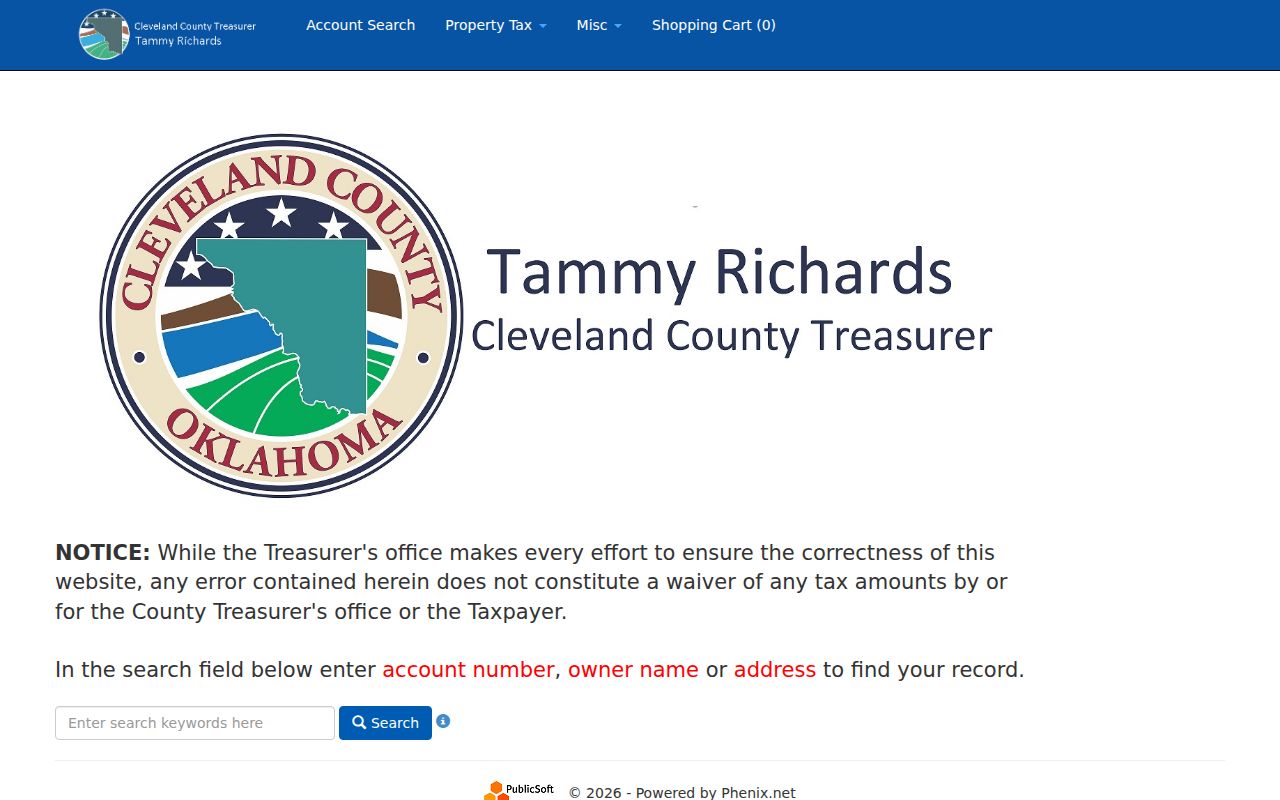
Use a tax account as context alongside the deed chain. It does not establish that every person associated with a past mailing address lived at the parcel.
Cleveland County Previous Residents Closeout
The end of an address trail is often an estate or a historical notice, not a final answer about every former occupant. An obituary can identify a death or later community. A probate docket can identify an estate case or heir relationship. A recorded estate conveyance can then connect the estate to the next transfer. Check the Court Clerk for public probate material and the County Clerk for the recorded deed that follows it.
Use careful language in notes: “last located in this source” is different from “last known resident.” A name may disappear because of a move, death, a changed street form, a record gap, or a source that did not include every household. That distinction keeps Cleveland County previous residents research accurate and fair.
Cleveland County Record-History Caution
Cleveland County’s first brick courthouse and jail burned in February 1904. The second courthouse was completed in 1906, and the present courthouse dates to 1939. This history is a reason to ask the Clerk and Court Clerk about surviving deed books, docket books, and later copies. Official sources do not identify exactly which record series were lost or reconstructed, so it is not sound to label all early records missing.
The county’s records have also changed format over time. Court matters were computerized in stages beginning in 1989 for civil, domestic, and criminal records, and in 1997 for probate and confidential records. A 2022 county agenda also recorded a proposed historical-record imaging and indexing project. These are changes in how records may be reached, not proof that every historic image is online. Cleveland County past residents research should preserve the source, date, and access path for each link in the trail.
Note: Ask the proper custodian about surviving sequences rather than treating a missing online result as proof that no record exists.