
Finding Cleveland County Residents
Cleveland County keeps separate records for property, recorded instruments, court cases, voter registration, and historical households. Start with the fact already in hand. An address belongs first in the Assessor search. A full name with date of birth belongs in the OK Voter Portal. An old Norman address belongs in a directory or newspaper. Each source answers a narrow question, and its date matters. An assessor result identifies an owner of record, not necessarily a person now living there. A docket identifies a party to a case, not a home address.
A practical Cleveland County residents directory search keeps a source-and-date note beside each result. That simple habit separates a parcel owner, a mailing contact, a registered voter, a court party, and a historical occupant. It also makes same-name mistakes easier to spot. When an online result is absent, ask the actual custodian for an existing record rather than expecting a new all-person report.
- Search the Cleveland County Assessor's Spatialest property search by owner, physical address, or parcel map when an address is known.
- Record the parcel number, situs address, mailing address, legal description, and the date shown before treating the name as a lead.
- Search the County Clerk's recorded-document index for the owner as grantee, then search the earlier party as grantor.
- For a one-person question, use the voter portal or OSCN with the identity details that distinguish the person from a namesake.
- For an older household, check OHS, a library directory, census records, and the relevant county office in that order.
Cleveland County Resident Records Offices
The County Clerk, Assessor, Court Clerk, Treasurer, and Election Board each control a different part of Cleveland County resident research. The County Clerk keeps deeds, mortgages, liens, plats, judgments, and other permanent county records. The Assessor maintains taxable property records and a parcel map. The Court Clerk maintains district-court files and marriage licenses. The Treasurer adds payment, balance, delinquency, and sale context. The Election Board handles voter records and the limits on voter-list requests. Street-by-street parcel work belongs on the Cleveland County Street Directory.
Cleveland County Clerk
201 S Jones Ave, Suite 210
Norman, OK 73069
405-366-0240
Cleveland County Assessor
201 S Jones Ave, Suite 120
Norman, OK 73069
405-366-0230
Cleveland County Election Board
641 E Robinson St
Norman, OK 73071
405-366-0210
Cleveland County Parcels by Address
The Spatialest application is the county's starting point for an address, owner name, or parcel-map search. The official county description confirms those three routes. Inspect the live property card for the details actually displayed, then preserve the parcel number and legal description. The physical, or situs, address identifies the property. A mailing address tells where tax notices go. They can be the same, but Cleveland County research should never assume that they are.
The live Cleveland County property search is shown below. It is useful for beginning a Cleveland County residents directory search from an address or map location.
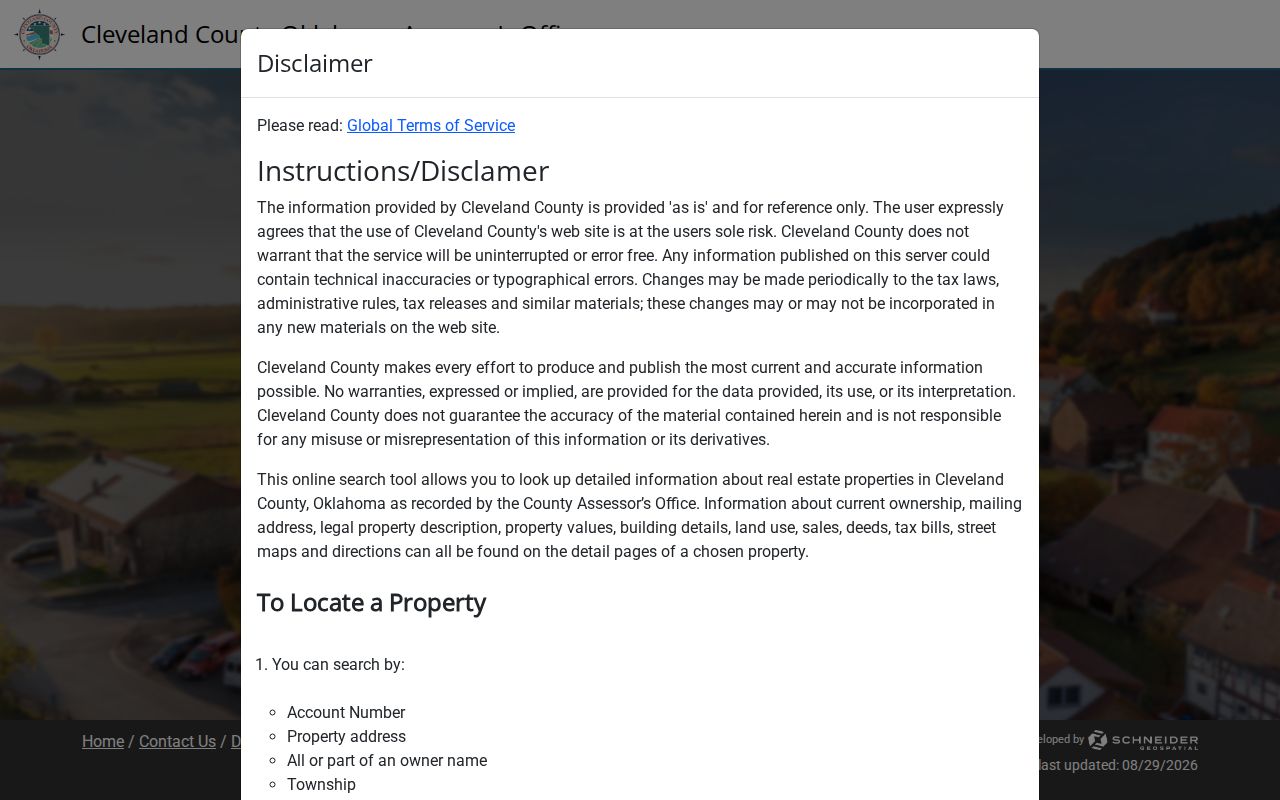
Use the visible result as a dated property record, then compare it to a deed and tax account before drawing a conclusion about a current household.
- Parcel
- A numbered property unit used by the Assessor and map system.
- Situs address
- The physical location assigned to a parcel for address and map use.
- Legal description
- The lot, block, survey, or metes-and-bounds description used in recorded instruments.
- Index
- A finding tool that points to a record; it is not the original instrument itself.
Cleveland County Deed Name Trails
The Clerk's Cogov index accepts document, name, subdivision, and date-oriented searches. Searchers should use exact formatting, narrow the date range, and add an asterisk after both last and first names where the index instructions call for it. For plat research, lot, block, and subdivision combinations matter. A grantee receives an interest; a grantor transfers one. Searching both roles is how a Cleveland County residents directory inquiry becomes a backward property trail.
The county's record-index disclaimer is a key limit. It warns that data and images can be inaccurate or altered and that the index is not dependable proof of title, transfer, foreclosure, or present ownership. Match the instrument's legal description to the assessor parcel, inspect the original at the Clerk's office when needed, and keep a similar name as a possible match until the property agrees.
Note: The county has not published a definitive online start year, so older book sequences and office indexes need direct confirmation.
Cleveland County Voter Record Checks
The OK Voter Portal is a one-person verification tool. It requires first name, last name, and date of birth as registered. A successful result can provide registration verification, precinct and polling information, status-related services, and ballot tools. It does not expose ballot choices, and the basic screen is not a street or neighborhood roster. Use the portal only when the identifying information is already known and respect protected-address results.
| Portal field | How Cleveland County uses it |
|---|---|
| First name | Required, using the registered form of the name. |
| Last name | Required, and worth testing against a documented name variant. |
| Date of birth | Required for identity verification in the basic lookup. |
| County | Not a visible basic-portal field in the inspected capture; use county context or contact the Board. |
Full voter-file access follows separate eligibility and use rules. Oklahoma protects driver-license and Social Security details, does not maintain voter phone numbers as a registration field, and shields some addresses through Restricted Records and the Address Confidentiality Program.
Norman Address Records in Cleveland County
Norman's CityView permit system adds a municipal layer for addresses inside its jurisdiction. It offers search by application number, address, parcel number, or name, with name options for Begins with and Contains. Status Detail, application fees, permit status, inspection status, plan tracking, and project inspections are named parts of the system. This makes CityView helpful for dated project history, not a complete roster of residents.
A permit can identify an applicant, contractor, or owner connected to a project. Those roles can differ. Cleveland County has no county planning and zoning commission, so permits and code matters should go to the relevant municipality. For a Norman record that is not online, the City Clerk is the routing point for a focused open-record request.
Current Cleveland County Resident Sources
No official Cleveland County residents directory lists every current household. The practical directory sources below cover different roles: recorded owner, voter registration, party to an instrument, court party, or official business contact. Use the source that fits the question. A record can confirm a connection without making a present-tense claim about where a person lives.
| Source | Connection shown | Custodian | Access route |
|---|---|---|---|
| Assessor parcel record | Recorded owner and property context | Cleveland County Assessor | Public Spatialest search |
| Recorded-document index | Parties to deeds, liens, and plats | Cleveland County Clerk | Free index; originals or copies at office |
| Voter registration | Registration identity and precinct context | Election Board | Name and date of birth; protections apply |
| Court docket | Party, case, event, and disposition | Court Clerk / OSCN | Public docket; office file rules apply |
| Business or license record | Official business or credential connection | State agency or board | Agency-specific public search |
For a name that needs careful confirmation, compare independent official sources in the resident lookup workflow. A court name and an owner name may be different people. An LLC or trust can own a parcel. A business agent's service address is not a residential conclusion.
Cleveland County Record Dates Matter
Official records and commercial people-finder products answer different questions. The private category can combine public records, marketing data, address histories, and self-reported or licensed material. That mix can lag behind a move, merge people with the same name, or repeat information that a current custodian protects. A Cleveland County residents directory search is more reliable when it begins with the office that created the underlying record and ends with the result's date.
| Research choice | Best use | Key limitation |
|---|---|---|
| Official assessor, clerk, court, or voter record | Checking a defined property, case, registration, or instrument | Each record speaks only to its stated date and purpose |
| Private compiled search result | Finding a lead to test with a custodian | May be stale, incomplete, or combine same-name people |
When sources conflict, preserve both citations and ask which office controls the original record. An assessor mailing contact should not override a newer recorded instrument, and neither should become a claim about a person's current address without a dated, matching source.
Cleveland County Dockets and Requests
OSCN is the starting index for many Cleveland County District Court matters. The Court Clerk remains the keeper for local files, certified copies, marriage licenses, and older written docket books. Civil, domestic, and criminal records were computerized in 1989, while probate and confidential records were computerized in 1997. Older matters need a different path through the Clerk rather than an assumption that an online name search is complete.
The Court Clerk receives mail requests at 200 S Peters Ave, Norman, and accepts email requests at MARILYN.WILLIAMS@OSCN.NET. The research lists $1 for the first copy page, $.50 for each additional page, $.50 per document for certification, $2 for a certified marriage license, and up to 10 business days after payment for completion. Ask for a defined case, date range, or document. The Oklahoma Open Records Act does not require an agency to create a custom resident report.
Note: A docket can show a party and case event, while a sealed or restricted filing may remain unavailable through the index.
Cleveland County Life Event Indexes
Birth, death, marriage, and divorce records do not share one custodian. The Oklahoma State Department of Health issues certified birth and death records, while the Court Clerk holds marriage licenses and court-file divorces. OK2Explore and Vital Records Service offer an index route for older events, but an indexed result does not make a certified copy available to every requester.
Oklahoma records began filing in 1908 and became mandatory in 1917, with uneven early compliance. Births at least 20 years old and deaths at least 5 years old are generally in the free index; the access map identifies broader opening rules of at least 125 years for birth records and 50 years for death records. Certified copies require the official application, identification, relationship or authorization, and payment under the state's rules.
Cleveland County Community Memory
Historical sources are often better at showing a former household than a current record. The Oklahoma Historical Society Research Center offers directories, yearbooks, newspapers, family histories, and research guidance. OHS Gateway adds free digitized newspapers, maps, photographs, and an 1893 Norman Transcript directory block. Pioneer Library System provides Ancestry Library Edition and local help across its service area, while the Cleveland County Historical Society preserves pioneer stories through the Moore-Lindsay House archive.
These are research collections, not modern contact lists. A historical directory can provide a name, spouse, occupation, address, or ownership notation for a year. Pair it with a deed, census, obituary, or probate filing before treating it as a family-history conclusion. The same careful method works across Norman, Moore, Noble, Lexington, Slaughterville, Little Axe, Newalla, and rural county communities.
Cleveland County's 1904 Records Break
Cleveland County's first brick courthouse and jail, at Gray Street and Ponca Avenue, burned in February 1904. The county says the replacement courthouse was completed in 1906, and the present courthouse dates to 1939. That history is a reason to ask the Clerk or Court Clerk about surviving book sequences when a search reaches the early county era. It is not proof that every pre-1904 record was lost.
The county's record systems also changed format later. Court computerization began in 1989 for civil, domestic, and criminal matters and in 1997 for probate and confidential records. A 2022 agenda item discussed imaging and indexing historical Clerk records, while the county's 2024 recovery plan documented continuity work. Those efforts help explain why an online index may be uneven without setting an unsupported coverage date.
Historical Cleveland County Directories
Norman Public Library holdings reach at least 1926, according to the OHS/SHPO material in the research. Cross-index directories run from the 1930s into the 1960s, and local phone books begin in the 1960s. OHS Gateway preserves a 1893 Norman Transcript directory block and a 1911 telephone-directory reference. The exact first and last directory years, publisher runs, and countywide reverse-directory coverage need volume-by-volume verification.
A criss-cross directory works from an address to a listed occupant, while a standard directory works from a name to an address. Both are historical evidence with their own dates and abbreviations. The Cleveland County City Directory examines the collection, entry details, census pairing, and archive route in depth.
Cleveland County Protected Addresses
Oklahoma public-record access has firm privacy boundaries. The state Address Confidentiality Program provides a substitute address for qualifying people who have relocated or plan to relocate after specified threats. Election Restricted Records also protect certain voters. Driver-license information is restricted under the federal DPPA, voter driver-license and Social Security data are confidential, and a voter phone number is not a maintained registration field.
For a mistaken entry, contact the office that controls the original record: the Assessor for a parcel record, County Clerk for an indexed instrument, Court Clerk for court material, Election Board for registration, or Vital Records for a certificate. A missing result may reflect a protected address, a sealed record, or a source that has not been digitized.